
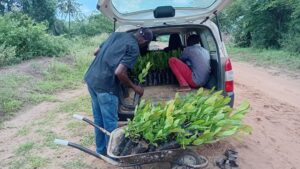
Planting afresh vs rehabilitating already existing farms – what works faster serves as best for now.
When discussions turn to increasing Kenya’s cashew production, the focus is often on planting new trees. While new orchards are important for the future, they are not the fastest path to increased production. The fastest opportunity is hidden in plain sight: the thousands of neglected cashew farms that already exist across the Kenyan coastal region.
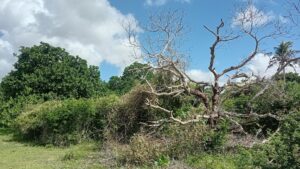
In Ganze Subcounty, Kilifi County, one of Kenya’s most suitable areas for cashew production, many farms tell the same story. Cashew trees stand scattered in overgrown bushes, largely abandoned after years of low returns and limited support. Dead trees are rarely replaced, leaving large gaps in orchards. Basic management practices such as pruning, sanitation, and pest control are often absent.
As a result, productivity remains far below what these farms are capable of producing.
One of the most visible challenges is pest infestation, particularly the cashew stem and root borer weevil. Left unmanaged, these pests weaken trees, reduce yields, and eventually kill them. Each dead tree represents lost income for farming families and lost production for the country’s cashew sector.
Yet these neglected farms also represent an enormous opportunity.
Unlike new orchards, which can take several years before they begin producing meaningful harvests, rehabilitated mature trees can respond much faster. Through pruning, pest management, replacement of dead trees, improved farm maintenance, and farmer support, productivity can increase within a relatively short period.
The trees are already in the ground. The land is already available. The farmers already possess valuable local knowledge. What is missing is the investment, technical support, and market confidence needed to bring these farms back to life.
At Mkoroshoni, we believe that rehabilitating neglected cashew farms is one of the quickes, most practical and cost-effective strategies for revitalizing Kenya’s cashew industry. Every neglected farm restored to productivity contributes to higher farmer incomes, increased national production, stronger rural economies, and renewed confidence in cashew farming as a profitable enterprise.
Kenya’s cashew revival does not begin with planting millions of new trees.
It begins by restoring the millions of trees that are already standing in our fields.
Follow for more